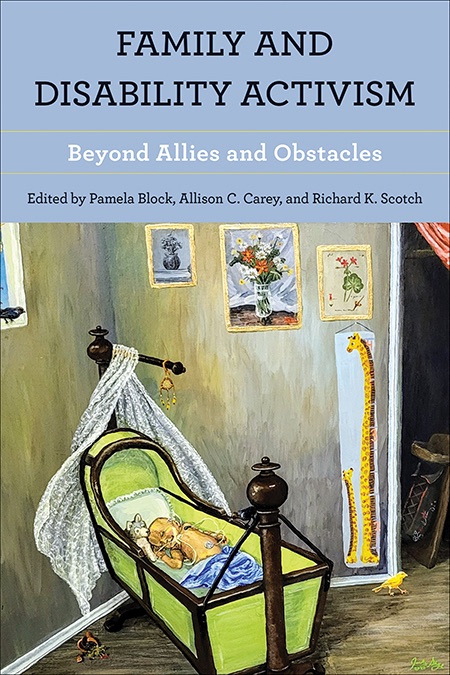
Edited volume · 2025
Family and Disability Activism
Beyond Allies and Obstacles
BIPOC and LGBTQIA2S+ disabled activists and families, in their own words.
Free audiobook188 pages
Display settings

Monograph · June 2020
Disability Activism and Parents of Children with Disabilities
Parents of children with disabilities have been among the most powerful forces in American disability policy — winning the right to a public education, pushing people out of institutions and into communities, and taking their fight to courts and legislatures. Yet many disabled activists have experienced parent advocacy as something that speaks over them rather than with them.
Allies and Obstacles traces that relationship across the twentieth and twenty-first centuries. Using a social-movement lens and four case studies — intellectual disability, psychiatric disability, autism, and physical disabilities such as cerebral palsy and muscular dystrophy — the authors show when parents and disabled activists have worked together, when they have clashed, and what each movement has gained and lost along the way.
An introduction, nine chapters in two parts, and a conclusion. Open any chapter for a summary, the story it opens with, its sections, and questions for classes and reading groups.
Sets out the book’s central puzzle. Parents have won some of the most important victories in disability policy, yet disabled activists often experience parent advocacy as speaking over them. The introduction traces how medicalization, “mother-blame,” and a neoliberal retreat from public support shape the pressures on families, and argues that parents are best understood not as simply allies or obstacles, but as “sometimes” allies.
How it opens
Opens with Sophia Grant, who in the 1930s was told by doctors to give her son Peter, born with Down syndrome, “a glass of milk and a cookie” and leave him alone — and who refused.
In this chapter
Questions for discussion
Part I
Four historical case studies, each tracing how parents and disabled people organized, where they found common cause, and where they collided.
Parents of people with intellectual disabilities were the first to organize on a national scale, founding the Arc in 1950. Over time they moved toward a social model of disability and a civil-rights frame, and many came to support self-advocacy. Yet the Arc’s role as a service provider, its claims to parental authority, and a sense among self-advocates that parents tried to control or co-opt their movement have kept the alliance uneasy.
How it opens
Opens with Emina, who built a parents’ group and then a national disability services department in Eastern Europe for her son Marsel before moving her family to the United States.
In this chapter
Questions for discussion
People with psychiatric diagnoses faced institutionalization and exclusion much like people with intellectual disabilities, but family organizing came later, with the National Alliance on Mental Illness founded in 1979. The chapter sets family groups focused on treatment, recovery, and sometimes involuntary care against a psychiatric survivor movement that criticizes the psychiatric profession itself.
How it opens
Opens with journalist Pete Earley’s struggle to get treatment for his adult son Mike, whose bipolar disorder brought the family into collision with hospitals, police, and the courts.
In this chapter
Questions for discussion
Autism was long folded into intellectual disability, and distinct parent advocacy only emerged once distinct treatments did. The chapter moves from the “refrigerator mother” era through the widening of autism into a spectrum, to the twenty-first-century “autism crisis” and the industry around it. Groups such as Autism Speaks pursued a highly medicalized politics of cure, in sharp contrast to autistic self-advocates who claim neurodiversity as identity — the so-called Autism Wars.
How it opens
Opens with Lisa and her son Jeremy, diagnosed before age two, and the years of therapies, school changes, and family sacrifices that led to Jeremy communicating with an AAC device.
In this chapter
Questions for discussion
Organizations such as United Cerebral Palsy, the Muscular Dystrophy Association, and the Easter Seal Society grew up around the same time as the Arc. This chapter follows their turn toward professional staff and large-scale fundraising, and the fierce protests disabled activists mounted against telethons that raised money by selling pity.
How it opens
Opens with Zona Roberts, whose son Ed contracted polio at fourteen. Her persistence helped him graduate, reach UC Berkeley, and become a founder of the independent living movement.
In this chapter
Questions for discussion
Part II
Stepping back from single communities to ask what explains the timing, frames, strategies, and language of parent activism across all of them.
Why did national parent organizations appear around 1950 for intellectual disability and cerebral palsy, but not until 1979 for mental illness or 2005 for autism? Oppression and diagnosis are necessary but not sufficient. What mattered was a diagnosis understood as a childhood condition, a sense of relative deprivation, new resources, and political opportunity — and, later, the successes of earlier parent groups, which newer groups built on or organized against.
In this chapter
Questions for discussion
Maps parent-led organizations by how closely their “frames” match those of disabled activists: a social versus medical model of disability, integration versus disability-specific settings, and who holds power and voice. The closer the match, the more likely the alliance. An earlier version appeared as “Sometimes Allies” in Disability Studies Quarterly (2019).
In this chapter
Questions for discussion
Parent organizations raise awareness, build and run services, lobby, and mobilize members. What divides them from disabled activists is usually the goal, not the tactic — with one exception. Parents rarely turn to protest and civil disobedience, which leaves disabled activists carrying most of the risk of direct action.
In this chapter
Questions for discussion
Shifts from organizations to parents’ own words. Parents describe rights as tools for access and equity, as respect, and as a path to services — and they claim rights for their families, rights of parents, and rights to family life. But they also describe rights failing: as a demand for productivity, as cover for cutting services, as a threat to safety, and as a competition for scarce resources. Need, more than rights, is what unites parents.
In this chapter
Questions for discussion
Needs and advocacy change across a lifetime: from the first diagnosis, through battles over treatment and school, to sexuality and adult roles, and finally to aging parents and interdependence. Lives are fluid, but service systems assume they stand still — nowhere more sharply than at the “disability cliff,” when school-based services end at twenty-one.
In this chapter
Questions for discussion
Must parents be either allies or obstacles? The authors argue against the binary. Parents tend to share three habits: they speak from their relationship to their child, they insist society take responsibility, and they claim authority over their child’s best interests. Alliance grows when parents share disabled activists’ commitment to the social model, integration, and empowerment — and when they are willing to cede power. The book ends by weighing rights against disability justice and calling for coalitions that lift up those most marginalized.
How it closes
Closes with two examples of what alliance can look like: Pamela’s mother, Barbara Kilcup, and her sister Hope, and the independent living pioneer Gini Laurie.
In this chapter
Questions for discussion
Explains how the research was done: organizational and archival documents, news reports, blogs and online forums, and twenty-seven interviews with parents, self-advocates, family members, and professionals.
From disabled activists’ point of view, parents are neither simply allies nor obstacles. At times they organize side by side, at times in opposition, and at times they are simply not paying attention.
Introduction; Chapter 6
For most parent activists, disability is not an individual experience. It affects whole families and communities, so society must share responsibility — and parents claim rights too.
Introduction
Parents demand support from the state while insisting on their own expertise over their children’s lives. That claim to authority is the deepest source of tension with disabled activists.
Introduction; Conclusion
The point, usually at twenty-one, when school-based services end and families face waiting lists and bureaucracy just as young adults are meant to be launching their lives.
Introduction; Chapter 9
Drawing on Alison Kafer, the book asks whose imagined futures shape policy. Self-advocates often envision jobs, homes, and marriages that parents struggle to picture — while some parents say “imagination” hides unmet need.
Introduction
Rights have opened doors, but they favor those with the resources to claim them. Disability justice asks for broader change that centers the people most marginalized.
Chapter 8; Conclusion
Parent organizations are most likely to ally with groups led by disabled activists when they share three commitments:
Social model over the medical model
Seeing disability as shaped by barriers in society, not only as a condition to be cured.
Integration over segregation
Working for access to ordinary schools, jobs, and communities rather than separate settings.
Empowerment over parental control
Letting disabled people lead, speak, and decide for themselves.
Disability language is contested, and different communities prefer different terms. The authors use each community’s preferred language when writing about it, moving between person-first and identity-first language as a sign of respect.
The book draws on organizational and archival documents, news coverage, blogs, and online forums, plus 27 interviews with activists aged 21 to 89. The interviews focused on people whose voices are least visible online, including older activists and self-advocates with intellectual disabilities.
Source: the book’s methods appendix. Interviewees are identified by pseudonyms.
This is a deeply personal project. Pamela’s mother, Barbara Kilcup, was a special education teacher and, when her children were young, a strident parent advocate. Over time, Barbara and Pamela’s sister Hope worked together and came to align closely with disabled activists. For Pamela, they showed how powerful a parent ally can be.
Allison grew up engaged with the intellectual disability community through her family and the Arc. Richard, whose career began with the history of disability civil rights, proposed that they write the book together.
Parents discovered long ago that they could accomplish far more by working to benefit all children with disabilities rather than just their own child.
From Chapter 5
National parent-led organizations and the years they were founded.
1949
Parent-led
1950
Parent-led
1967
Parent-led
1979
Parent-led
1983
Parent-led
1989
Parent-led
1997
Parent-led
2005
Parent-led
Edited volume · 2025
Beyond Allies and Obstacles
BIPOC and LGBTQIA2S+ disabled activists and families, in their own words.
Free audiobook188 pages